
 Admin
Admin 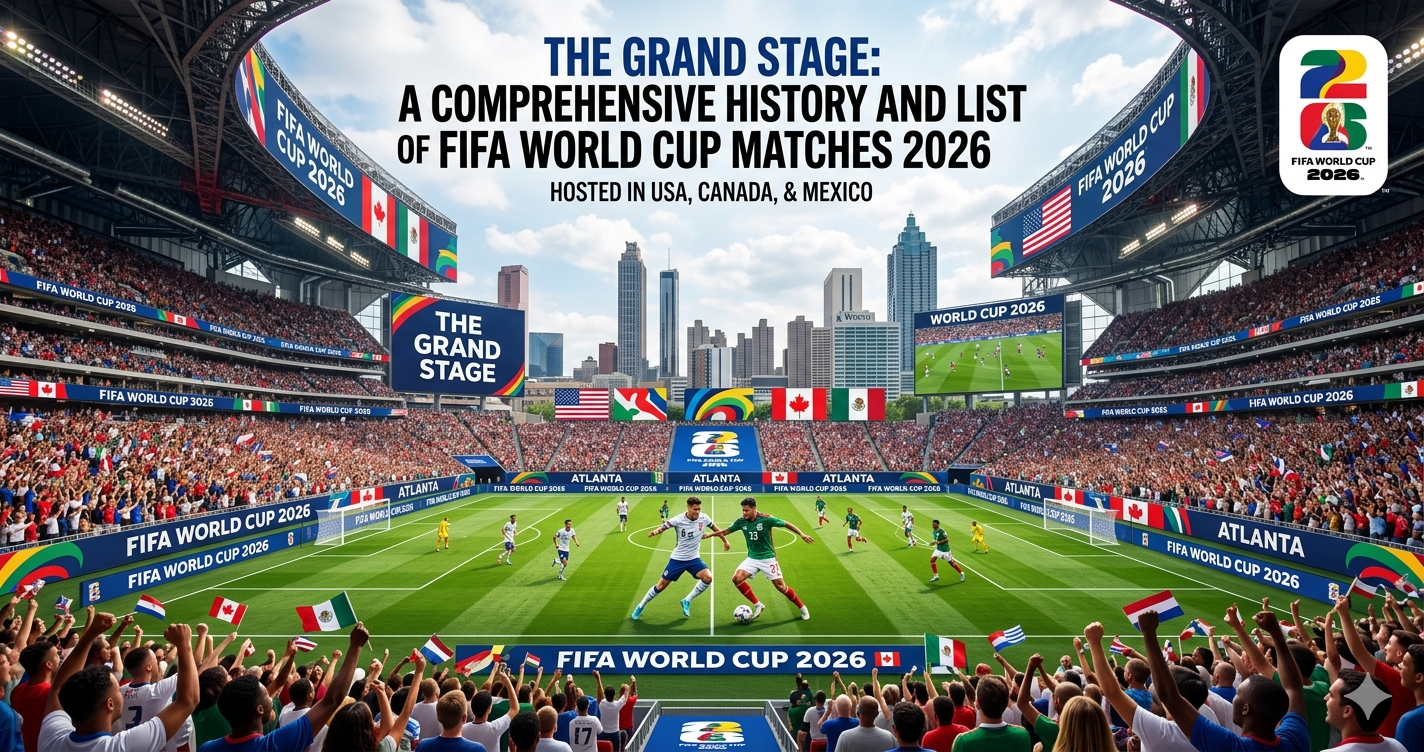
The FIFA World Cup stands as the pinnacle of global sports, a quadrennial festival that unites nations, transcends borders, and creates legends. At the heart of this global phenomenon are the matches themselves—ninety minutes (and sometimes more) of pure drama, skill, and passion. Since the inaugural tournament in Uruguay in 1930, the World Cup has evolved dramatically, expanding from a modest 13-team invitational to a colossal 48-team tournament.
This comprehensive guide explores the evolution of the FIFA World Cup match format, provides a historical ledger of how the number of matches has grown over the decades, highlights some of the most iconic clashes in the tournament’s history, and offers a detailed look at the sprawling 104-match schedule of the upcoming 2026 FIFA World Cup in North America.
The Evolution of the World Cup Match Format
The structure of the World Cup has undergone numerous transformations to accommodate the growing global popularity of soccer. As more nations joined FIFA and the quality of international football improved across continents, the tournament naturally had to expand.
The Early Years (1930–1950)
The first World Cup in 1930 featured only 13 teams and a total of 18 matches. The format was relatively straightforward, with teams divided into four groups, and the group winners advancing directly to the semi-finals. By 1934 and 1938, the tournament adopted a straight knockout format from the beginning, consisting of a Round of 16, quarter-finals, semi-finals, and the final. This ruthless format left no room for error and resulted in 17 and 18 total matches, respectively.
Following the interruption caused by World War II, the World Cup returned in 1950 in Brazil. This tournament featured a unique format with no traditional knockout final. Instead, the four group winners advanced to a final round-robin group. The decisive match between Uruguay and Brazil, famously known as the Maracanazo, effectively served as the final.
Finding a Rhythm (1954–1978)
From 1954 to 1970, the tournament settled into a 16-team format. The standard structure involved four groups of four teams, with the top two from each group advancing to the quarter-finals. This created a steady tournament length of 32 to 35 matches (depending on tie-breaking playoffs in 1958). In 1974 and 1978, FIFA experimented with a second group stage instead of direct knockout quarter-finals and semi-finals, increasing the total match count to 38.
The Modern Expansions (1982–2022)
The first major expansion occurred in 1982 when the tournament grew to 24 teams. This era introduced the 52-match tournament, allowing for more representation from Africa, Asia, and North America. The format was refined in 1986 to include a knockout Round of 16, which proved highly popular.
In 1998, France hosted the first 32-team World Cup. This format—eight groups of four, followed by a 16-team knockout bracket—was widely praised for its competitive balance and simplicity. It produced exactly 64 matches and remained the gold standard for seven consecutive tournaments, culminating in the 2022 World Cup in Qatar.
Historical Ledger: Number of Matches per Tournament
To understand the sheer scale of the World Cup’s growth, one must look at the number of fixtures played in each edition. Over 22 tournaments, the total number of matches has more than tripled.
| Year | Host Nation(s) | Total Matches | Champion |
| 1930 | Uruguay | 18 | Uruguay |
| 1934 | Italy | 17 | Italy |
| 1938 | France | 18 | Italy |
| 1950 | Brazil | 22 | Uruguay |
| 1954 | Switzerland | 26 | West Germany |
| 1958 | Sweden | 35 | Brazil |
| 1962 | Chile | 32 | Brazil |
| 1966 | England | 32 | England |
| 1970 | Mexico | 32 | Brazil |
| 1974 | West Germany | 38 | West Germany |
| 1978 | Argentina | 38 | Argentina |
| 1982 | Spain | 52 | Italy |
| 1986 | Mexico | 52 | Argentina |
| 1990 | Italy | 52 | West Germany |
| 1994 | United States | 52 | Brazil |
| 1998 | France | 64 | France |
| 2002 | South Korea / Japan | 64 | Brazil |
| 2006 | Germany | 64 | Italy |
| 2010 | South Africa | 64 | Spain |
| 2014 | Brazil | 64 | Germany |
| 2018 | Russia | 64 | France |
| 2022 | Qatar | 64 | Argentina |
| 2026 | USA / Mexico / Canada | 104 | TBD |
Memorable Matches That Defined the Tournament
While the statistics and formats provide the framework, it is the matches themselves that breathe life into the history of the FIFA World Cup. Certain fixtures have transcended the sport to become cultural milestones.
The Miracle of Bern (1954 Final)
- West Germany 3 – 2 HungaryThe “Golden Team” of Hungary was widely considered invincible, having gone unbeaten for four years and thrashing West Germany 8-3 earlier in the group stage. However, in the final, amidst heavy rain, West Germany mounted a stunning comeback from 2-0 down to win 3-2, marking a pivotal moment in the nation’s post-war history.
The Game of the Century (1970 Semi-Final)
- Italy 4 – 3 West Germany (a.e.t.)Played at the Estadio Azteca in Mexico City, this match saw five goals scored in extra time alone. The sheer physical exhaustion, combined with relentless attacking play and Franz Beckenbauer playing with a dislocated shoulder in a sling, etched this fixture into football folklore.
The Hand of God and the Goal of the Century (1986 Quarter-Final)
- Argentina 2 – 1 EnglandDiego Maradona dominated this match with two of the most famous goals ever scored. The first was his highly controversial, unpenalized handball (“The Hand of God”), and the second came just four minutes later—a mesmerizing 60-yard dribble past five English players that was later voted the Goal of the Century.
The Mineirazo (2014 Semi-Final)
- Germany 7 – 1 BrazilHost nation Brazil, burdened by the immense pressure of winning on home soil, suffered the most shocking defeat in World Cup history. Germany dismantled the Brazilian defense with surgical precision, scoring five goals in the first 29 minutes and leaving an entire nation in stunned silence.
The Modern Masterpiece (2022 Final)
- Argentina 3 – 3 France (Argentina won 4-2 on penalties)Widely regarded as the greatest final ever played, this match saw Lionel Messi and Kylian Mbappé trade blows in a spectacular showcase. Mbappé scored a hat-trick to repeatedly pull France back from the brink, but Argentina ultimately triumphed in the shootout, cementing Messi’s legacy.
The 2026 Revolution: 48 Teams and 104 Matches
The upcoming 2026 FIFA World Cup, jointly hosted by the United States, Mexico, and Canada, marks the most ambitious expansion in the tournament’s history. For the first time, 48 national teams will compete on the global stage.
Initially, FIFA proposed a format of 16 groups of three teams, yielding 80 total matches. However, concerns over collusion in the final group games led to a revised structure. The tournament will now feature 12 groups of four teams, ensuring that the top two teams from each group, along with the eight best third-place teams, advance to a newly introduced Round of 32.
This monumental shift expands the tournament from 64 to a staggering 104 matches spread across 39 days, testing the endurance and squad depth of every participating nation like never before.
Key Tournament Dates for 2026
- Group Stage: June 11 – June 27
- Round of 32: June 28 – July 3
- Round of 16: July 4 – July 7
- Quarter-Finals: July 9 – July 11
- Semi-Finals: July 14 – July 15
- Third-Place Match: July 18
- Final: July 19
2026 FIFA World Cup: Selected Group Stage Match List
With the expanded schedule, keeping track of the fixtures is more critical than ever. The tournament will kick off on June 11, 2026, with the hosts Mexico taking on South Africa at the legendary Estadio Azteca.
Below is a detailed list of the opening Group Stage fixtures for the 2026 FIFA World Cup across the various host cities (times listed in IST).
Matchday 1 (June 12 – June 17, 2026)
| Date (IST) | Group | Matchup | Time (IST) |
| June 12 | A | Mexico vs South Africa | 12:30 AM |
| June 12 | A | South Korea vs Czechia | 7:30 AM |
| June 13 | B | Canada vs Bosnia & Herzegovina | 12:30 AM |
| June 13 | D | USA vs Paraguay | 6:30 AM |
| June 14 | B | Qatar vs Switzerland | 12:30 AM |
| June 14 | C | Brazil vs Morocco | 3:30 AM |
| June 14 | C | Haiti vs Scotland | 6:30 AM |
| June 14 | D | Australia vs Türkiye | 9:30 AM |
| June 14 | E | Germany vs Curaçao | 10:30 PM |
| June 15 | F | Netherlands vs Japan | 1:30 AM |
| June 15 | E | Ivory Coast vs Ecuador | 4:30 AM |
| June 15 | F | Sweden vs Tunisia | 7:30 AM |
| June 15 | H | Spain vs Cape Verde | 9:30 PM |
| June 16 | G | Belgium vs Egypt | 12:30 AM |
| June 16 | I | France vs Senegal | 12:30 AM |
| June 16 | H | Saudi Arabia vs Uruguay | 3:30 AM |
| June 16 | I | Iraq vs Norway | 3:30 AM |
| June 16 | G | Iran vs New Zealand | 6:30 AM |
| June 17 | J | Argentina vs Algeria | 6:30 AM |
| June 17 | J | Austria vs Jordan | 9:30 AM |
| June 17 | K | Portugal vs DR Congo | 10:30 PM |
Matchday 2 (June 18 – June 23, 2026)
| Date (IST) | Group | Matchup | Time (IST) |
| June 18 | L | England vs Croatia | 1:30 AM |
| June 18 | L | Ghana vs Panama | 4:30 AM |
| June 18 | K | Uzbekistan vs Colombia | 7:30 AM |
| June 18 | A | Czechia vs South Africa | 9:30 PM |
| June 19 | B | Switzerland vs Bosnia & Herzegovina | 12:30 AM |
| June 19 | D | USA vs Australia | 12:30 AM |
| June 19 | B | Canada vs Qatar | 3:30 AM |
| June 19 | C | Scotland vs Morocco | 3:30 AM |
| June 19 | A | Mexico vs South Korea | 6:30 AM |
| June 20 | C | Brazil vs Haiti | 6:00 AM |
| June 20 | D | Türkiye vs Paraguay | 8:30 AM |
| June 20 | F | Netherlands vs Sweden | 10:30 PM |
| June 21 | E | Germany vs Ivory Coast | 1:30 AM |
| June 21 | E | Ecuador vs Curaçao | 5:30 AM |
| June 21 | F | Tunisia vs Japan | 9:30 AM |
| June 21 | H | Spain vs Saudi Arabia | 9:30 PM |
| June 22 | G | Belgium vs Iran | 12:30 AM |
| June 22 | H | Uruguay vs Cape Verde | 3:30 AM |
| June 22 | G | New Zealand vs Egypt | 6:30 AM |
| June 22 | J | Argentina vs Austria | 10:30 PM |
Matchday 3 (June 24 – June 28, 2026)
The final group stage matches are crucial, with teams fighting for the top two spots or aiming to be among the eight best third-placed finishers. Under FIFA regulations, final group games in the same bracket are played simultaneously to prevent match manipulation.
| Date (IST) | Group | Matchup | Time (IST) |
| June 24 | L | England vs Ghana | 1:30 AM |
| June 24 | L | Panama vs Croatia | 4:30 AM |
| June 24 | K | Colombia vs DR Congo | 7:30 AM |
| June 25 | B | Switzerland vs Canada | 12:30 AM |
| June 25 | B | Bosnia & Herzegovina vs Qatar | 12:30 AM |
| June 25 | C | Morocco vs Haiti | 3:30 AM |
| June 25 | C | Scotland vs Brazil | 3:30 AM |
| June 25 | A | South Africa vs South Korea | 6:30 AM |
| June 25 | A | Czechia vs Mexico | 6:30 AM |
| June 26 | E | Curaçao vs Ivory Coast | 1:30 AM |
| June 26 | E | Ecuador vs Germany | 1:30 AM |
| June 26 | F | Tunisia vs Netherlands | 4:30 AM |
| June 26 | F | Japan vs Sweden | 4:30 AM |
| June 26 | D | Türkiye vs USA | 7:30 AM |
| June 26 | D | Paraguay vs Australia | 7:30 AM |
| June 27 | I | Norway vs France | 12:30 AM |
| June 27 | I | Senegal vs Iraq | 12:30 AM |
| June 27 | H | Cape Verde vs Saudi Arabia | 5:30 AM |
| June 27 | H | Uruguay vs Spain | 5:30 AM |
| June 27 | G | New Zealand vs Belgium | 8:30 AM |
| June 27 | G | Egypt vs Iran | 8:30 AM |
| June 28 | L | Panama vs England | 2:30 AM |
| June 28 | L | Croatia vs Ghana | 2:30 AM |
| June 28 | K | Colombia vs Portugal | 5:00 AM |
| June 28 | K | DR Congo vs Uzbekistan | 5:00 AM |
| June 28 | J | Algeria vs Austria | 7:30 AM |
| June 28 | J | Jordan vs Argentina | 7:30 AM |
(Note: Match schedules and knockout stage progressions are subject to final confirmations and real-time tournament results.)
Conclusion
The list of matches in the FIFA World Cup represents more than just a schedule; it is a roadmap of international sports history. From the 18 fixtures played on the dusty pitches of Uruguay in 1930 to the highly anticipated 104 matches scheduled across the cutting-edge stadiums of North America in 2026, the World Cup’s growth mirrors the globalization of the beautiful game itself.
Whether you are looking at the historical ledger of past tournaments or mapping out your viewing schedule for the 2026 edition, every match holds the potential for heartbreak, triumph, and moments of absolute brilliance that will be remembered for generations to come. The expansion to 48 teams guarantees that more nations will have the opportunity to write their names into the World Cup match history books, promising an unparalleled festival of football.


Hi, this is a comment.
To get started with moderating, editing, and deleting comments, please visit the Comments screen in the dashboard.
Commenter avatars come from Gravatar.