
FIFA World Cup 2026: Mexico — Host Cities, Stadiums, Team & Fixtures
 Admin
Admin 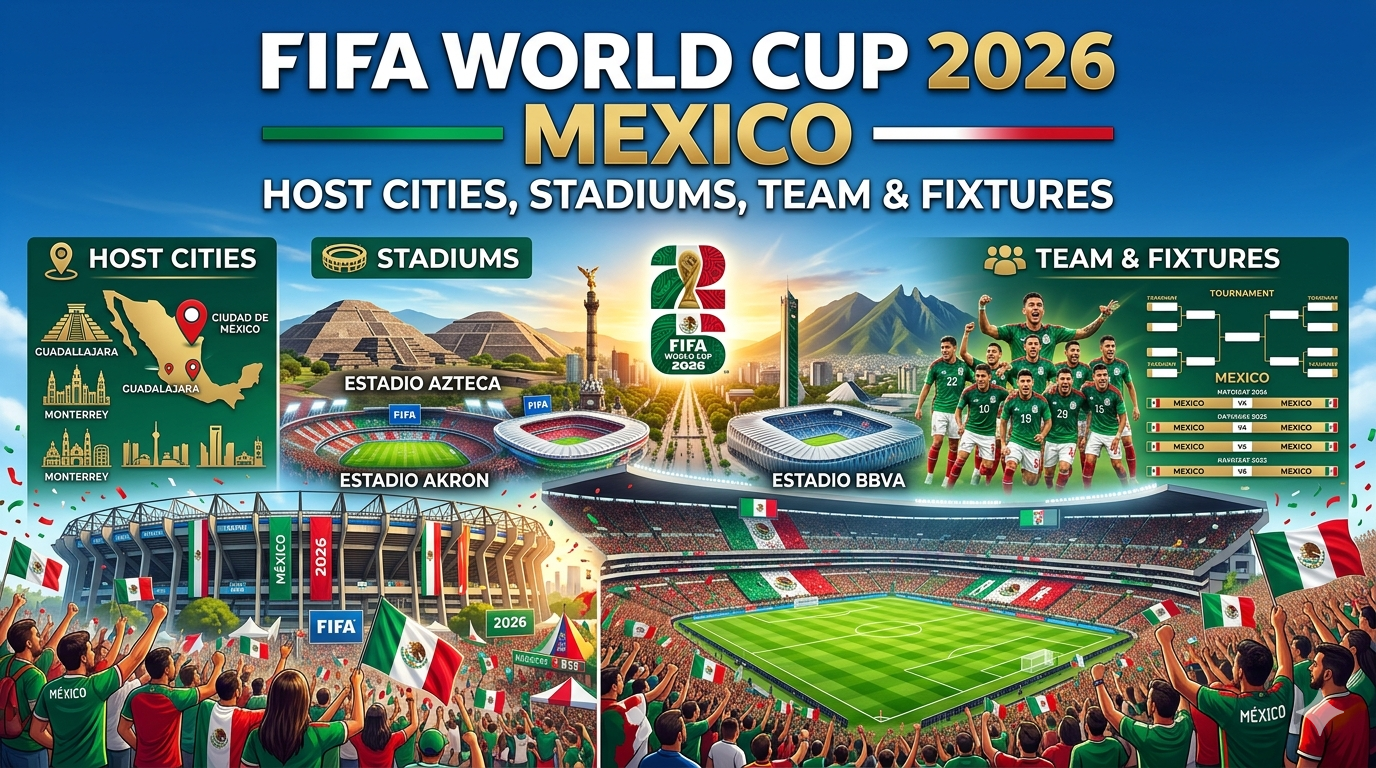
Introduction
The FIFA World Cup 2026 is the largest football tournament in history, featuring 48 nations competing across 104 matches from June 11 to July 19, 2026. For the first time ever, the tournament is jointly hosted by three nations — the United States, Canada, and Mexico — spread across 16 cities and 16 stadiums.
Mexico holds a uniquely historic distinction in this edition: it becomes the first nation in the world to host FIFA World Cup matches for the third time, having previously staged the tournament in 1970 and 1986. This milestone cements Mexico’s place as one of football’s most iconic host nations.
Mexico’s Role as Host Nation
Mexico is hosting matches across three cities — Mexico City, Guadalajara, and Monterrey — with a combined total of 13 matches taking place on Mexican soil. These venues span the group stage through to the round of 32, making Mexico a central hub of the tournament’s early action.
Mexico’s official mascot for the 2026 World Cup is Zayu the Jaguar, representing the nation’s rich cultural heritage and natural spirit.
Mexican Host Cities and Stadiums
1. Mexico City — Estadio Ciudad de México (Estadio Azteca / Banorte)
The jewel of Mexico’s hosting role, the Mexico City Stadium (historically known as Estadio Azteca, now officially branded as Estadio Banorte) is the most iconic football venue in the Americas. It made history as the venue for the tournament’s opening match on June 11, 2026 — becoming the first stadium ever to host three FIFA World Cup opening matches, having done so in 1970 and 1986 as well.
The stadium previously hosted two World Cup finals (1970 and 1986) and set a youth tournament attendance record of 98,943 at the FIFA U-17 World Cup Final in 2011. Mexico City itself is North America’s most vibrant metropolis, home to over 150 museums — the second-highest count of any city globally.
Matches Hosted: Group stage matches including Mexico’s opening fixture and third group game, plus a Round of 32 clash.
2. Guadalajara — Estadio Guadalajara (Estadio Akron)
Often considered the cultural capital of Mexico, Guadalajara is the birthplace of mariachi music, the home of tequila, and a city known for its year-round festivals. The Estadio Guadalajara (Estadio Akron), inaugurated in 2010, is a striking spherical, coliseum-like structure built on raised ground — one of the most visually distinctive venues at the 2026 World Cup.
With a seating capacity of just over 48,000–49,000, the stadium previously hosted the 2010 Copa Libertadores Final, the FIFA U-17 World Cup in 2011, and the Pan-American Games. The home club, C.D. Guadalajara, celebrated Liga MX double titles and CONCACAF Champions League glory within its walls.
Matches Hosted: Four group-stage matches, including Mexico vs. Korea Republic on June 18, plus matches involving Colombia, Uruguay, and Spain.
3. Monterrey — Estadio Monterrey (Estadio BBVA)
Monterrey’s Estadio BBVA is a sleek, modern stadium with a capacity of approximately 53,000. Located in one of Mexico’s most industrious and passionate footballing cities, Monterrey provides a world-class atmosphere. The stadium also hosted the 2025 World Cup inter-confederation playoff tournament, alongside Guadalajara.
Matches Hosted: Three group-stage games and one Round of 32 match.
Mexico’s Group Stage — Group A
As a co-host, Mexico earned automatic qualification and was placed in Group A alongside:
| Team | FIFA Ranking (June 2026) |
|---|---|
| 🇲🇽 Mexico (co-host) | — |
| 🇿🇦 South Africa | — |
| 🇰🇷 Korea Republic | — |
| 🇨🇿 Czechia | — |
All three of Mexico’s group-stage fixtures are played on home soil — a unique privilege reserved for the co-host nations.
Group A Fixtures (Mexico)
| Date | Match | Venue | Result |
|---|---|---|---|
| June 11, 2026 | Mexico vs. South Africa | Mexico City Stadium | Mexico 2–0 South Africa |
| June 18, 2026 | Mexico vs. Korea Republic | Estadio Guadalajara | — |
| June 24–25, 2026 | Czechia vs. Mexico | Mexico City Stadium | — |
Mexico opened their campaign with an emphatic 2–0 victory over South Africa on June 11 at the Estadio Azteca — the same venue and opponent as the 2010 World Cup’s famous opening match (which ended 1–1). The result put El Tri top of Group A from matchday one.
Mexico’s National Team — El Tri
Head Coach: Javier Aguirre
Veteran tactician Javier Aguirre leads Mexico into the 2026 World Cup, with legendary defender Rafael Márquez serving as assistant coach. Márquez is expected to take over as head coach following the tournament.
Key Players
Goalkeeper
- Guillermo Ochoa (AEL Limassol) — A national icon appearing in a record sixth FIFA World Cup, Ochoa remains one of football’s most celebrated goalkeepers.
Defenders
- César Montes (Lokomotiv Moscow)
- Johan Vásquez
- Jesús Gallardo (Toluca)
Midfielders
- Edson Álvarez (Captain) (Fenerbahçe) — The defensive midfield anchor and leader of El Tri.
- Orbelín Pineda
- Álvaro Fidalgo
- Luis Chávez
Forwards
- Santiago Giménez (AC Milan) — One of Mexico’s biggest attacking threats, offering pace and clinical finishing.
- Raúl Jiménez (Wolverhampton Wanderers) — The experienced attacking leader known for his physical presence and finishing ability.
Young Star
- Gilberto Mora — Set to become the youngest Mexican player ever to appear at a World Cup, aged just 17.
Mexico’s World Cup History
Mexico’s participation in the 2026 FIFA World Cup carries enormous historical weight:
- 1930: Mexico appeared in the first-ever World Cup in Uruguay.
- 1970 & 1986: Mexico hosted and reached the quarter-finals on both occasions.
- 1994–2018: Consistent round-of-16 appearances, known as “El Quinto Partido” (the fifth game) — the elusive quarter-final spot that El Tri has sought for decades.
- 2022 (Qatar): Mexico failed to advance from the group stage for the first time since 1978, making qualification for 2026 via the co-host berth especially meaningful.
- 2026: As host nation, Mexico opens the entire tournament — a moment of enormous national pride.
Other Matches Played in Mexico (Full List)
Beyond Mexico’s own fixtures, the three Mexican stadiums host a wide range of Group A, Group F, Group H, Group J, and other group-stage matches, as well as knockout-round ties. Notable games hosted in Mexico include:
Mexico City Stadium (Estadio Azteca)
- Mexico vs. South Africa — Group A (June 11)
- Uzbekistan vs. Colombia — Group J (June 17)
- Czechia vs. Mexico — Group A (June 24/25)
- Round of 32 match (Mexico City) — Winner Group A vs. Third-Place team (June 30)
Estadio Guadalajara (Akron)
- Korea Republic vs. Czechia — Group A (June 12)
- Mexico vs. Korea Republic — Group A (June 18)
- Colombia vs. DR Congo — Group J (June 23)
- Spain vs. Uruguay — Group H (June 26)
Estadio BBVA Monterrey
- Tunisia vs. Japan — Group F (June 15)
- South Africa vs. Korea Republic — Group A (June 24/25)
- Netherlands vs. Tunisia — Group F (June 25)
- Round of 32 match — Winner Group F vs. Runner-Up Group C (June 29)
Tournament Format
For the first time in World Cup history, the 2026 edition uses a 12-group format of four teams each, replacing the previous system of eight groups of four. Under this expanded format:
- The top two teams from each of the 12 groups advance to the knockout rounds.
- The eight best third-place finishers across all groups also advance.
- This creates a Round of 32 — a brand-new stage in World Cup history — followed by the Round of 16, Quarter-finals, Semi-finals, and the Final.
- Teams now play up to eight matches from group stage through to lifting the trophy.
The FIFA World Cup 2026 Final will be held on July 19, 2026, at MetLife Stadium in New York/New Jersey.
Conclusion
Mexico’s role in the FIFA World Cup 2026 is unprecedented. Hosting the tournament for a historic third time, the country brings three iconic stadiums, passionate fans, and a rich footballing culture to the world’s biggest sporting stage. With the legendary Estadio Azteca staging the opening ceremony and kickoff, El Tri playing all group games before their own fans, and 13 total matches lighting up Mexican cities, the 2026 World Cup promises to be a defining chapter in Mexican football history.
Whether El Tri can finally break past the dreaded “fifth game” barrier and reach the quarter-finals — backed by roaring home crowds — is the question gripping the nation.
Tournament dates: June 11 – July 19, 2026 | Host nations: USA, Mexico, Canada | Total matches: 104 | Teams: 48