 Sparkup Media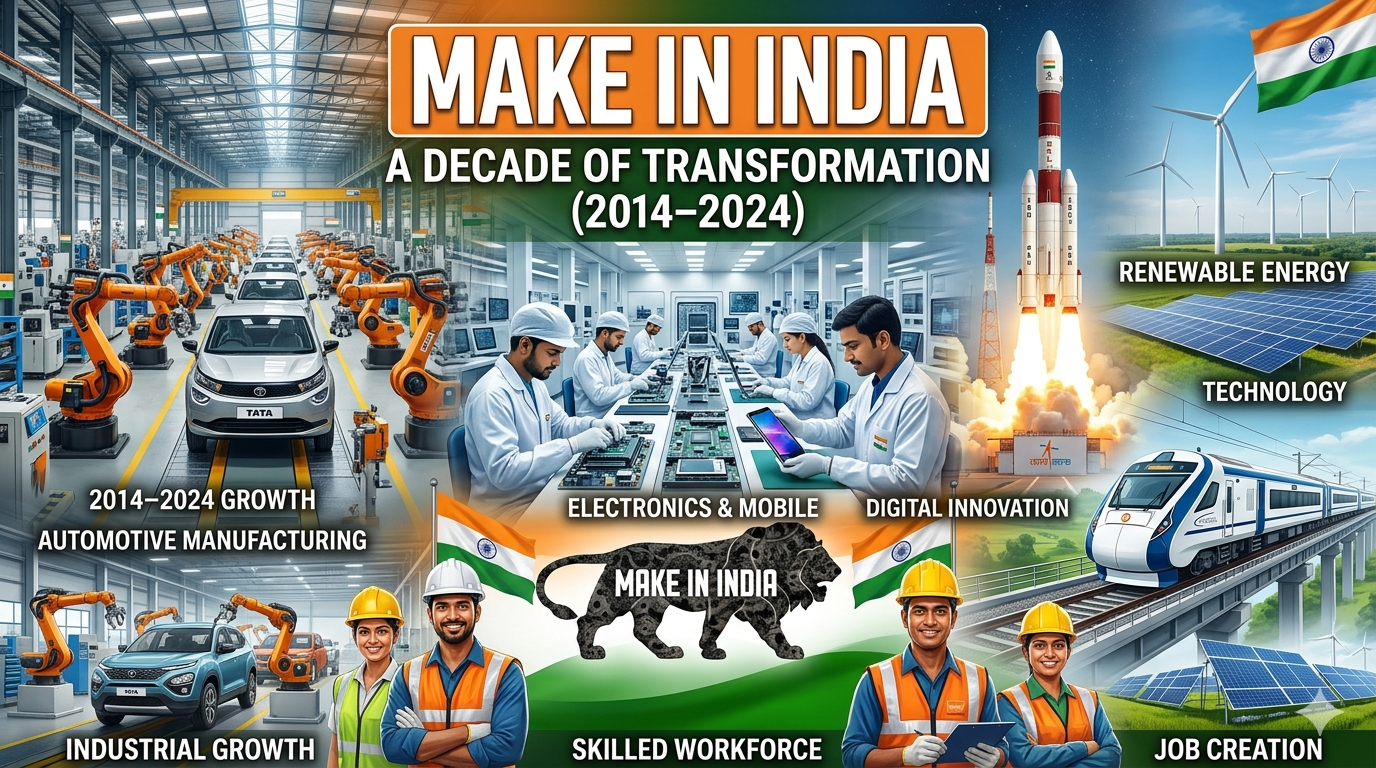
What the BJP Government Achieved in 10 Years Under the Make in India Initiative
Introduction
On September 25, 2014, Prime Minister Narendra Modi launched one of independent India’s most ambitious economic programmes — Make in India. Its goal was bold and clear: transform India from a service-dominated economy into a global manufacturing powerhouse, create millions of jobs, attract foreign investment, and build the foundations of a self-reliant nation. A decade later, the results paint a complex but largely forward-moving picture — of record investments, policy reforms, sectoral breakthroughs, and persistent challenges still to be overcome.
The Vision: What Was Promised
At its launch, Make in India set three primary targets:
- Raise the manufacturing sector’s share of GDP to 25% by 2022 (later revised to 2025)
- Achieve a manufacturing growth rate of 12–14% per annum
- Create 100 million additional manufacturing jobs by 2022
These were audacious goals for a country where manufacturing had long lagged behind the services sector. But the Modi government bet heavily on India’s demographic dividend, its growing middle class, and the global desire to diversify supply chains away from China.
Pillar 1: Ease of Doing Business — A Quiet Revolution
One of the most measurable achievements of Make in India has been India’s dramatic improvement in the World Bank’s Ease of Doing Business Index. India ranked 142nd in 2014; by 2019, it had climbed to 63rd — a jump of 79 places in just five years. This was not accidental. The government systematically dismantled red tape, digitised application processes, and simplified licensing rules at both central and state levels.
Key reforms included:
- GST implementation (July 2017): The Goods and Services Tax unified 36 states and union territories into a single common market, ending the cascading burden of multiple taxes and making cross-state business significantly easier.
- Labour law consolidation: 29 separate labour laws were merged into just four codes, bringing much-needed clarity and flexibility for businesses while protecting worker rights.
- FDI liberalisation: 100% Foreign Direct Investment was permitted across most sectors. Restrictions were eased in insurance, medical devices, railways, and defence manufacturing.
- Digital governance: File-based approvals were replaced with IT-driven, trackable online processes, drastically reducing bureaucratic delays.
By the end of 2017, India had also risen 42 places on the World Economic Forum’s Global Competitiveness Index and 19 notches on the Logistics Performance Index.
Pillar 2: Record Foreign Direct Investment
Perhaps the most striking number of the Make in India decade is this: between April 2014 and March 2024, India attracted $667.41 billion in FDI — nearly 67% of all FDI the country received in the last 24 years. This is a testament to the sustained confidence global investors have placed in India’s growth story.
FDI inflows grew steadily from $45.14 billion in 2014–15 to a record $84.83 billion in 2021–22. In FY 2023–24, total FDI stood at $70.95 billion, with equity inflows of $44.42 billion. Sectors like electronics, pharmaceuticals, automobiles, food processing, and defence attracted the lion’s share.
The 2016 “Make in India Week” in Mumbai alone generated investment commitments worth over ₹15.2 lakh crore (approx. $160 billion), with delegations from 68 countries and business teams from 72 nations.
Pillar 3: The PLI Scheme — Game Changer for Manufacturing
Launched in 2020 as a direct extension of Make in India’s philosophy, the Production Linked Incentive (PLI) Scheme has been the single biggest policy lever of the decade. Spanning 14 key sectors — including mobile phones, pharmaceuticals, textiles, food processing, solar panels, advanced chemistry cell batteries, medical devices, and telecom equipment — the PLI scheme ties financial incentives to incremental production targets.
Results by mid-2024:
- 755 applications approved across PLI sectors
- ₹1.23 lakh crore in investment realised by March 2024
- ~8–9.5 lakh direct jobs created under PLI
- ₹12.50 lakh crore in production generated
- ₹4 lakh crore in exports driven by PLI beneficiaries
Electronics & Mobile Manufacturing
India emerged as the world’s second-largest mobile phone manufacturer under this decade. Apple’s manufacturing ecosystem in India — through partners like Foxconn and Tata — generated 1,75,000 new direct jobs, with over 72% of roles filled by women. India’s mobile phone exports surged from near-zero to billions of dollars annually.
Pharmaceuticals
The PLI scheme for pharma positioned India as the third-largest pharmaceutical player globally by volume, with 50% of production now directed towards exports.
Telecom
India achieved 60% import substitution in telecom products under the PLI scheme, with global companies setting up manufacturing units for 4G and 5G equipment within the country.
Textiles
India is today the world’s second-largest producer of textiles and garments, accounting for 4.6% of global trade, and the third-largest textile exporter after China and Germany. The textile PLI scheme projected investments of over ₹28,000 crore and a turnover exceeding ₹2,00,000 crore.
Pillar 4: Defence Manufacturing — From Importer to Exporter
Perhaps the most dramatic sectoral transformation has been in defence manufacturing. India was historically one of the world’s largest defence importers. Under Make in India:
- Indigenous fighter jets, naval ships, and advanced weaponry are now being manufactured domestically.
- Defence exports have surged from nearly zero to over ₹21,000 crore (approx. $2.5 billion) in 2023–24.
- The government reserved specific defence items exclusively for domestic procurement.
- The Tejas fighter jet, INS Vikrant (India’s first indigenous aircraft carrier), Akash missile systems, and other platforms became symbols of India’s defence self-reliance.
Pillar 5: Infrastructure — PM GatiShakti
Recognising that poor infrastructure was a major drag on manufacturing competitiveness, the government launched PM GatiShakti in October 2021. This digital platform integrates planning across 36 Ministries and Departments, enabling multimodal and last-mile connectivity in a coordinated way. From road and rail to ports, airports, and energy grids, GatiShakti represents a “whole-of-government” approach to infrastructure that Make in India desperately needed.
The Railways sector alone saw the rollout of 136 Vande Bharat trains by December 2024, all manufactured domestically — a symbol of Make in India in action.
Pillar 6: Semiconductors & Future Technology
In 2021, India launched the Semicon India Programme with incentives exceeding $10 billion to attract global semiconductor manufacturers. Companies from the US, Japan, and Taiwan have shown strong interest. This is critical because semiconductor chips power everything from smartphones to defence systems, and over-reliance on imports — as exposed during the COVID-era chip shortage — is a national vulnerability India is actively addressing.
Pillar 7: Startups & Innovation Ecosystem
The Startup India initiative, launched in January 2016 as a complement to Make in India, has produced extraordinary results. As of September 2024, India boasts the third-largest startup ecosystem in the world, with over 1,48,931 DPIIT-recognised startups creating more than 15.5 lakh direct jobs. From fintech to agritech, edtech to spacetech, Indian startups are now competing globally.
Challenges and Criticism: The Unfinished Agenda
A balanced account must also acknowledge where Make in India has fallen short.
Manufacturing’s share of GDP has not grown as promised. It stood at 16.7% in 2013–14 and actually declined to approximately 14–16% by 2023–24, well below the 25% target. The COVID-19 pandemic, global supply chain disruptions, and structural challenges in India’s labour market all played a role.
Job creation has lagged. While millions of jobs have been created, the scale falls far short of the original goal of 100 million new manufacturing jobs. Automation and global economic pressures have made this target even harder to achieve.
Infrastructure gaps persist. Despite GatiShakti and increased capital expenditure, logistics costs in India remain higher than in competing nations like Vietnam and Bangladesh in certain sectors.
China comparison: While India has benefited from global “China+1” diversification strategies, capturing a larger share of manufacturing moving out of China has been slower than hoped.
Conclusion: A Foundation Built, A Summit Still Ahead
Ten years of Make in India represents one of the most sustained and multi-dimensional industrial policy efforts in India’s post-independence history. Record FDI, a transformed electronics sector, a rising defence industry, PLI-powered manufacturing growth, a booming startup ecosystem, and historic improvements in ease of doing business — these are real and measurable achievements.
Yet the journey to make India a genuine global manufacturing hub — one that can rival China, South Korea, or Germany — is far from complete. The next decade will test whether the foundation laid between 2014 and 2024 can support the weight of India’s ambitions: a $5 trillion economy, a 25% manufacturing GDP share, and hundreds of millions of well-paying industrial jobs.
If Make in India’s first decade was about planting seeds, the next must be about the harvest.
Sources: PIB Government of India, KPMG India, JLL India, Wikipedia – Make in India, Press Information Bureau 2024
A decade of Make in India
Make In India | Prime Minister of India
Reflecting on a Decade of Make in India: Achievements, Challenges, and the Road Ahead
10 Years of Make in India
Make in India – Wikipedia
Major Initiatives | Prime Minister of India
Transforming India into a Global Manufacturing Powerhouse
Year Ender: 10 years of ‘Make in India’ initiative hit new peaks in 2024
10 Years of Make in India | TaxTMI
About the Author