 Admin
Admin 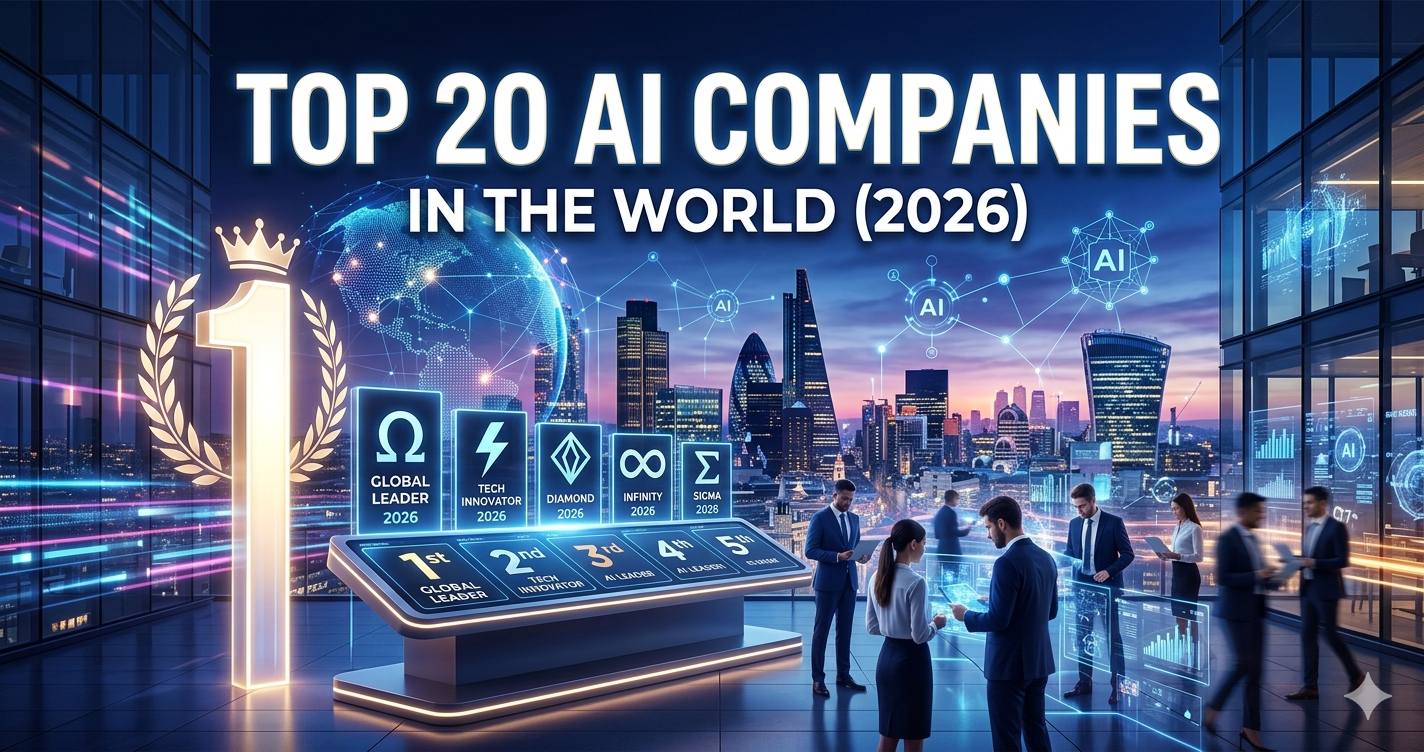
The artificial intelligence industry has reached a turning point. In 2026, AI is no longer a technology being tested in labs — it is the engine driving business, healthcare, science, and daily life. Private funding for AI startups topped $150 billion over the past twelve months, and the combined valuation of the ten largest AI companies now exceeds $2 trillion. Here is a definitive look at the 20 companies shaping the future of artificial intelligence.
1. OpenAI
Headquarters: San Francisco, USA | Founded: 2015
OpenAI is the world’s most prominent AI company and the creator of ChatGPT, GPT-5, and the o-series reasoning models. With a valuation of approximately $852 billion following a record $122 billion funding round led by Amazon, NVIDIA, and SoftBank, it stands as one of the most valuable private companies in history. OpenAI processes over 15 billion tokens per minute via its API and serves more than 900 million weekly users across consumer and enterprise products. GPT-5, launched in August 2025, quickly became the benchmark other models are measured against. The company is reportedly planning a public debut in September 2026 at a potential $1 trillion valuation.
Key Products: ChatGPT, GPT-5, DALL·E, Codex, Sora, OpenAI API Speciality: Foundation models, multimodal AI, reasoning
2. Anthropic
Headquarters: San Francisco, USA | Founded: 2021
Anthropic has emerged as the most valuable standalone AI startup in 2026, reaching a valuation of $965 billion after its $65 billion Series H closed in late May 2026. The company’s run-rate revenue crossed $47 billion in May 2026, and it projects its first-ever operating profit in Q2 2026. Anthropic is known for its safety-first approach to AI development, pioneered through its Constitutional AI methodology — a technique that encodes ethical principles directly into the model’s behavior. The Claude family of models powers enterprise automation, coding assistance, research, and customer engagement globally. Anthropic has filed for an IPO at $965 billion, making it one of the most anticipated public listings in technology history.
Key Products: Claude 4 (Opus, Sonnet, Haiku), Claude Code, Claude API Speciality: Safe AI, enterprise models, Constitutional AI
3. Google DeepMind
Headquarters: London, UK / Mountain View, USA | Founded: 2010 (merged 2023)
Google DeepMind is the unified AI research and product arm of Alphabet, combining the former Google Brain and DeepMind teams. It is the force behind Gemini — Google’s flagship family of multimodal AI models — as well as AlphaFold, which revolutionized protein structure prediction for the entire scientific community. DeepMind pushes the boundaries of foundational AI research while feeding cutting-edge capabilities into Google Search, Google Cloud, and Workspace. With Alphabet’s resources and a world-class research team, DeepMind remains one of the deepest and most influential AI organizations on the planet.
Key Products: Gemini, AlphaFold, AlphaCode, Imagen, Veo Speciality: Foundational research, multimodal AI, scientific AI
4. NVIDIA
Headquarters: Santa Clara, USA | Founded: 1993
NVIDIA is the indispensable backbone of the AI industry. Its H100, H200, and Blackwell-series GPUs power the vast majority of AI training and inference workloads across the world’s largest data centers. NVIDIA is not just a chipmaker — it has built a complete AI computing platform through CUDA, NIM (NVIDIA Inference Microservices), and partnerships with every major cloud provider. As one of the largest public companies by market capitalization, NVIDIA also participated as a strategic investor in OpenAI’s historic $122 billion funding round. Without NVIDIA’s silicon, the AI boom as we know it would not exist.
Key Products: H200, Blackwell GPUs, CUDA, NeMo, NIM, DGX Cloud Speciality: AI hardware, GPU computing, AI infrastructure
5. Microsoft
Headquarters: Redmond, USA | Founded: 1975
Microsoft has woven AI into the very fabric of its product ecosystem through its deep partnership with OpenAI and the development of Copilot. By early 2026, Microsoft Copilot was active in over one million enterprise seats, helping professionals build presentations from notes, write code, manage cloud systems with natural language, and handle multi-step automation tasks. Azure AI revenue grew 33% quarter-over-quarter in Q4 2024. Microsoft’s renegotiated partnership with OpenAI (May 2026) resets revenue-share terms ahead of OpenAI’s expected IPO, ensuring Microsoft remains the primary distribution partner for the world’s most-used AI models.
Key Products: Microsoft Copilot, Azure AI, GitHub Copilot, Bing AI Speciality: Enterprise AI integration, cloud AI, developer tools
6. Meta AI
Headquarters: Menlo Park, USA | Founded: 2004
Meta has become the world’s leading proponent of open-source AI through its LLaMA family of models. The company’s decision to release model weights publicly has democratized AI development and sparked significant industry debate about safety versus accessibility. Meta’s research teams publish extensively on efficient training, model compression, and multimodal systems — work that influences the entire field. On the consumer side, Meta AI is embedded across WhatsApp, Instagram, Facebook, and Messenger, reaching billions of users daily. The company operates massive data center infrastructure optimized for training large-scale neural networks.
Key Products: LLaMA 4, Meta AI Assistant, Code Llama Speciality: Open-source AI, social AI integration, research
7. xAI (Elon Musk)
Headquarters: San Francisco, USA | Founded: 2023
xAI, Elon Musk’s AI venture, closed a $20 billion funding round in January 2026 and has rapidly grown into one of the most heavily capitalized AI companies in the world. Its Grok models, integrated natively into X (formerly Twitter), offer a contrarian, real-time approach to AI assistance. In a landmark development, xAI filed its S-1 publicly on May 20, 2026, with IPO pricing in June 2026 under the ticker SPCX on Nasdaq. Following a merger with SpaceX, the combined xAI-SpaceX entity is targeting a valuation of $1.75 trillion — making it potentially the most valuable company ever to go public.
Key Products: Grok 3, Grok Vision, xAI API Speciality: Real-time AI, open questioning, consumer AI
8. Amazon Web Services (AWS) AI
Headquarters: Seattle, USA | Founded: 1994
Amazon is one of the most influential players in the AI infrastructure and deployment ecosystem. Through AWS, it provides the cloud backbone on which thousands of AI companies build their products — including a $50 billion strategic investment in OpenAI. AWS offers Amazon Bedrock (a managed service for accessing foundation models from Anthropic, Meta, and others), SageMaker for model training and deployment, and its own Alexa+ AI assistant. Amazon’s investment in Anthropic — its chosen partner for frontier AI — gives it deep ties to some of the most advanced models available in the enterprise market.
Key Products: Amazon Bedrock, SageMaker, Alexa+, AWS Trainium, Inferentia Speciality: Cloud AI infrastructure, enterprise AI deployment
9. Apple
Headquarters: Cupertino, USA | Founded: 1976
Apple has taken a privacy-first, on-device approach to AI with Apple Intelligence — its suite of AI features launched with iOS 18 and macOS Sequoia. Rather than routing data to the cloud, Apple processes many AI tasks directly on-device using its Neural Engine chips. Apple Intelligence includes writing tools, smart summarization, image generation, and a vastly upgraded Siri powered by partnership integrations with OpenAI. Apple’s approach signals a major bet that the future of AI for consumers will be private, personal, and portable — running on the billions of iPhones, Macs, and iPads already in people’s hands.
Key Products: Apple Intelligence, Siri, Core ML, Neural Engine Speciality: On-device AI, privacy-preserving AI, consumer AI
10. IBM
Headquarters: Armonk, USA | Founded: 1911
IBM is one of the world’s oldest technology companies and remains a significant force in enterprise AI, particularly in regulated industries like finance, healthcare, and government. Its watsonx platform provides a suite of enterprise-grade AI tools for building, fine-tuning, and governing AI models, with a strong emphasis on transparency and explainability. IBM also leads in quantum computing — a technology that promises to dramatically accelerate certain AI workloads in the coming decade. For large organizations needing trustworthy, auditable AI, IBM continues to be the go-to partner.
Key Products: watsonx.ai, Watson, IBM Granite models, IBM Quantum Speciality: Enterprise AI, AI governance, quantum computing
11. Baidu
Headquarters: Beijing, China | Founded: 2000
Baidu is China’s dominant search engine and its leading AI company. Its ERNIE (Enhanced Representation through Knowledge Integration) family of large language models competes directly with GPT-level systems, and its ERNIE Bot product — rebranded as Wenxin Yiyan — has attracted hundreds of millions of users across China. Baidu also leads in autonomous driving through its Apollo platform, one of the most mature self-driving vehicle programs in the world. As US chip export restrictions tighten, Baidu has accelerated investment in domestic AI chip development to reduce dependence on NVIDIA hardware.
Key Products: ERNIE Bot, Apollo (autonomous driving), PaddlePaddle Speciality: Chinese-language AI, autonomous vehicles, AI search
12. Perplexity AI
Headquarters: San Francisco, USA | Founded: 2022
Perplexity AI is redefining how people search for information. Instead of returning a list of blue links, Perplexity delivers direct, cited answers drawn from live web sources — combining the intelligence of large language models with real-time internet access. The company reached an $80 million revenue run rate by the end of 2024, and its valuation rose to approximately $22.6 billion by mid-2026. Perplexity represents the leading edge of “answer engines” — a new category of AI-native information products that many believe will significantly disrupt traditional web search.
Key Products: Perplexity Answer Engine, Perplexity API, Perplexity Pro Speciality: AI search, real-time information retrieval
13. Mistral AI
Headquarters: Paris, France | Founded: 2023
Mistral AI is Europe’s most important AI company and the strongest challenger to US dominance in foundation model development. Founded by former DeepMind and Meta researchers, Mistral has built a reputation for releasing powerful open-weight models that developers worldwide use freely. Its annual revenue has reportedly exceeded $100 million, tripling in a single quarter in 2025. The company is backed by NVIDIA and the French government, and has invested €1.2 billion in a Swedish data center. In 2025, it launched Magistral, a reasoning model designed for complex multilingual tasks. Mistral holds a unique regulatory advantage under the EU AI Act, giving it a strong foothold in European enterprise markets.
Key Products: Mistral Large, Mistral Small, Magistral, Le Chat Speciality: Open-weight models, European AI, multilingual AI
14. Salesforce AI (Einstein)
Headquarters: San Francisco, USA | Founded: 1999
Salesforce has embedded AI throughout its Customer 360 platform through Einstein AI — a suite of predictive analytics, generative tools, and autonomous agents designed for sales, marketing, customer service, and commerce teams. With Agentforce, Salesforce’s 2025 flagship product, companies can deploy AI agents that autonomously handle customer inquiries, qualify leads, and manage service tickets. Salesforce processes enormous amounts of enterprise CRM data, giving its models a proprietary advantage in understanding business relationships and customer behavior at scale.
Key Products: Salesforce Einstein, Agentforce, Einstein Copilot, Data Cloud Speciality: CRM AI, enterprise AI agents, business automation
15. Scale AI
Headquarters: San Francisco, USA | Founded: 2016
Scale AI occupies a critical and often underappreciated position in the AI supply chain: it provides the high-quality human-labeled training data that makes large language models smart. Without Scale’s data pipelines, many of today’s frontier AI models would not exist. The company has a valuation of approximately $13 billion and counts the US Department of Defense, OpenAI, Meta, and Microsoft among its major clients. In 2026, as companies recognize that proprietary training data is one of the most defensible AI assets, Scale’s position at the intersection of human intelligence and AI training becomes increasingly valuable.
Key Products: Scale Data Engine, Donovan (defense AI), RLHF pipelines Speciality: AI training data, RLHF, government AI
16. Databricks
Headquarters: San Francisco, USA | Founded: 2013
Databricks has evolved from a data analytics company into one of the most important AI infrastructure platforms for enterprises. With a valuation of $134 billion, it helps large organizations build, fine-tune, and run AI models on their own proprietary data — a critical capability for companies unwilling to send sensitive information to third-party AI providers. Its open-source DBRX model demonstrated that foundation models can be built outside the traditional AI lab structure. Databricks also acquired MosaicML to deepen its model training capabilities, positioning itself as the enterprise AI data platform of choice.
Key Products: Databricks Lakehouse, DBRX, MLflow, Unity Catalog Speciality: Enterprise data AI, fine-tuning, AI governance
17. Waymo (Alphabet)
Headquarters: Mountain View, USA | Founded: 2009
Waymo is the world’s most advanced autonomous vehicle company and has successfully commercialized fully driverless ride-hailing in multiple US cities. A subsidiary of Alphabet, Waymo raised $16 billion in early 2026 — one of the four largest venture rounds in history — as it scales its robotaxi fleet. Waymo’s AI systems process data from cameras, radar, and LiDAR in real time to navigate complex urban environments without human oversight. The company represents one of the most impressive real-world deployments of AI in physical space, with millions of autonomous miles logged and a safety record that surpasses human drivers.
Key Products: Waymo One (robotaxi), Waymo Driver, Waymo Via (freight) Speciality: Autonomous vehicles, real-world AI deployment, robotics
18. Cohere
Headquarters: Toronto, Canada | Founded: 2019
Cohere is a leading enterprise AI company known for building large language models specifically optimized for business use cases — not consumer chatbots. Its Command family of models focuses on reliability, data privacy, and deployment flexibility, allowing enterprise clients to run AI models on their own private cloud or on-premises infrastructure. This makes Cohere particularly attractive to financial services, healthcare, and legal firms with strict data residency requirements. The company’s Retrieval-Augmented Generation (RAG) technology, branded as Cohere Rerank and Embed, is widely used to make enterprise knowledge bases searchable with AI.
Key Products: Command R+, Embed, Rerank, Cohere Platform Speciality: Enterprise NLP, private AI deployment, RAG
19. Hugging Face
Headquarters: New York, USA | Founded: 2016
Hugging Face is the GitHub of AI — the central open-source hub where researchers, developers, and companies share, discover, and deploy machine learning models. With over 1 million models hosted on its platform and a vibrant community of millions of developers, Hugging Face has become the connective tissue of the AI research community. Its Transformers library is used in virtually every major AI research lab worldwide. Hugging Face is not just a repository — it also offers Inference Endpoints, Spaces for hosting AI demos, and AutoTrain for no-code model fine-tuning. Its community-centric model has made it one of the most influential companies in democratizing AI.
Key Products: Hugging Face Hub, Transformers library, Inference Endpoints, Spaces Speciality: Open-source AI, model hosting, developer community
20. Palantir Technologies
Headquarters: Denver, USA | Founded: 2003
Palantir occupies a unique position in the AI landscape: it specializes in applying AI to the hardest, highest-stakes problems faced by governments and large enterprises. Its Artificial Intelligence Platform (AIP) allows organizations to deploy large language models on sensitive, classified, or proprietary data — without that data leaving their control. Palantir’s clients include the US Army, NATO, the NHS, and major financial institutions. As AI increasingly intersects with national security and critical infrastructure, Palantir’s deep relationships and specialized expertise position it as an irreplaceable player in the defense and intelligence AI market.
Key Products: AIP (Artificial Intelligence Platform), Foundry, Gotham, Apollo Speciality: Defense AI, enterprise data intelligence, government AI
The Big Picture
The AI industry in 2026 is defined by a clear hierarchy. At the apex sit the foundation model companies — OpenAI, Anthropic, Google DeepMind, xAI, and Mistral — which control the core technology and attract the majority of venture capital. Enabling them is hardware infrastructure led by NVIDIA, whose GPUs remain the essential compute substrate. Above the model layer, enterprise platforms like Microsoft, Salesforce, Databricks, and IBM translate AI capabilities into business value. And at the frontier of physical AI, companies like Waymo are proving that intelligence can navigate the real world, not just the digital one.
What unites all twenty companies on this list is a shared conviction: artificial intelligence is not a feature. It is the platform on which the next era of human progress will be built.
Here’s a fully researched article covering the Top 20 AI Companies in the World (2026), complete with valuations, key products, founding details, and strategic positioning.
Here’s a quick snapshot of the rankings:
| # | Company | Speciality |
|---|---|---|
| 1 | OpenAI | Foundation models, ChatGPT (~$852B valuation) |
| 2 | Anthropic | Safe AI, Claude (~$965B valuation) |
| 3 | Google DeepMind | Foundational research, Gemini |
| 4 | NVIDIA | AI hardware, GPU computing |
| 5 | Microsoft | Enterprise AI, Copilot |
| 6 | Meta AI | Open-source AI, LLaMA |
| 7 | xAI | Grok, real-time AI (~$1.75T IPO target) |
| 8 | AWS AI | Cloud AI infrastructure |
| 9 | Apple | On-device, privacy-first AI |
| 10 | IBM | Enterprise AI governance |
| 11 | Baidu | Chinese-language AI, autonomous driving |
| 12 | Perplexity AI | AI search & answer engine |
| 13 | Mistral AI | Open-weight models, European AI |
| 14 | Salesforce AI | CRM AI agents |
| 15 | Scale AI | AI training data |
| 16 | Databricks | Enterprise data AI (~$134B) |
| 17 | Waymo | Autonomous vehicles |
| 18 | Cohere | Private enterprise AI |
| 19 | Hugging Face | Open-source AI hub |
| 20 | Palantir | Defense & government AI |
Article based on publicly available data and funding announcements as of June 2026.